Signal priority for emergency services and public transport

The right of way already exists. Let the junction deliver it.

A camera on the approach recognises an emergency vehicle or a late bus and requests a green from the traffic signal. No powered equipment on the vehicle. The controller always decides.

The problem

This ambulance is allowed to cross this red light. It is not going to.

The rule already exists in every country we work in. What is missing is a way to act on it in live traffic, without relying on every driver to react correctly within seconds.
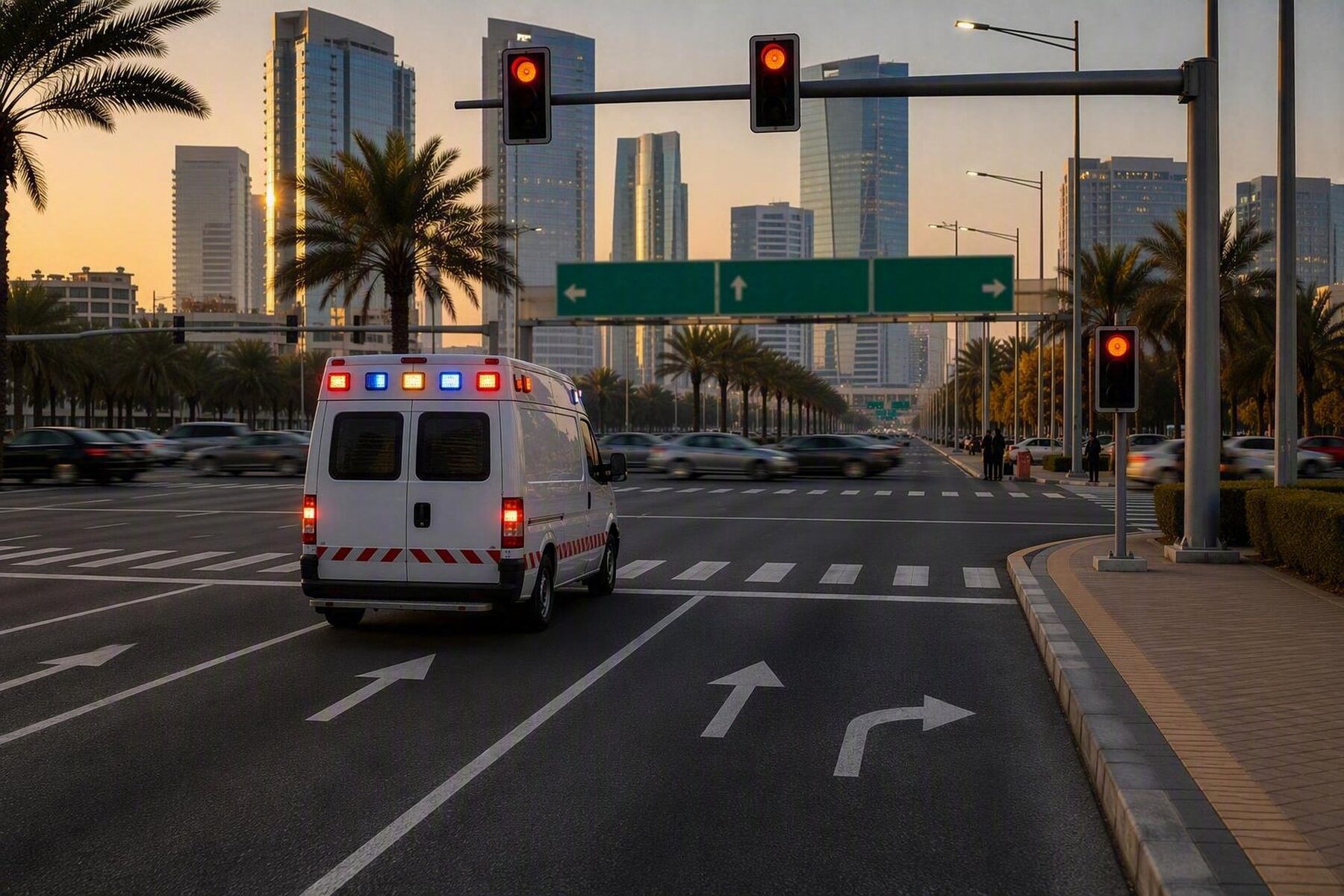
An ambulance with its lights on, held at a red signal while cross traffic moves
Allowed to cross. Not going to.
1

The law is clear

Failing to give way to an emergency vehicle is an offence everywhere. In Abu Dhabi it carries a Dh3,000 fine, six black points and thirty days without the car.

2

The driver may cross

An emergency vehicle on a call may pass a red light when it is safe to do so.

3

It is never safe

The cross traffic has green. It keeps moving. So the ambulance waits, at a junction where it is legally entitled to proceed.

The same problem, on a timetable

A full bus waits like a single car.

60people on the bus
1person in the car
Samered light

The signal cannot tell the difference, because nothing at the junction knows the bus is late. Location data arrives every 10 to 30 seconds and drifts by 90 to 100 metres. An embedded loop in the road registers presence and nothing else. So the bus that is eight minutes behind and the bus that is four minutes early get the same treatment, which is none.

What has been tried

Three things work. None of them is finished.

Education

Campaigns in several languages ask drivers to give way. They help. But they rely on every driver reacting correctly within seconds, in traffic, in a city whose drivers learned the rules in many different countries.

Enforcement

Cameras on emergency vehicles now record drivers who fail to give way and issue the fine. The offence is recorded after the ambulance has already waited.

Signal priority, with hardware

An emitter in the vehicle, a receiver on the junction. It works, but only for the vehicles somebody paid to fit. In one Gulf city, hundreds of junctions can give priority, but only to the few vehicles fitted with the equipment to ask for it.

The first two ask the driver to decide. The third asks the junction, but only for a vehicle carrying a transmitter.

How it works

One camera. One request. The junction does the rest.

The camera sees the approach, not the junction. The decision is made and the request submitted before the vehicle reaches the stop line.

CAM EMERGENCY APPROACH
1

See

A camera on the approach detects the vehicle about 100 metres before the junction and fixes its precise position. The processing happens at the junction. No video leaves it.

2

Confirm

Is it an emergency vehicle with its emergency lights on, or a bus that is running late? Where a dispatch or fleet feed exists, it adds a further check.

3

Clear

The controller brings the green forward, or extends it, for the prioritised vehicle. The cross traffic gets a normal amber and a normal red, at normal rates.

4

Restore

The vehicle passes. The junction returns to its original timings. Recovery belongs to the controller.

A vehicle with its emergency lights off is ordinary traffic and is treated as ordinary traffic.

The product

Nothing powered on the vehicle.

SmartClearway recognises the vehicle from the roadside. A camera on the approach detects it, classifies it and checks whether its emergency lights are on. A bus is identified by a printed marker on its front. The junction receives a signal priority request. No powered equipment is fitted to any vehicle.

No fitting programme

No vehicle comes off the road. No emitter, no beacon, no per-vehicle cost that grows with the fleet. A bus marker is a printed sticker, fitted in minutes.

Whole-fleet coverage

Every marked emergency vehicle running its lights qualifies: private ambulances, mutual aid and any vehicle bought next year. Covered from the day the camera goes up.

Nothing new in the ground

A camera on a pole that is already there, a computer in the cabinet beside the controller. It works with the controllers and signal infrastructure already installed, and can use existing cameras.

The junction will

  • Bring the green forward, or extend it, as the controller decides.
  • Give the cross traffic a normal red, at a normal rate.
  • Return to its original timings once the vehicle passes.

The junction will not

  • Shorten a minimum green or an intergreen.
  • Cut a pedestrian phase that is already running.
  • Take any control away from the controller.

We send a signal priority request. The controller decides. It can refuse.

Who it is for

Built for the people who own the problem.

One platform, two applications. The camera, the request and the safety envelope are the same. Only the eligibility check changes: emergency lights on for an emergency vehicle, late by an agreed threshold for a bus.

Emergency services

Police, ambulance, fire and civil defence. Every marked vehicle running its lights gets priority, including the ones you do not own.

  • Private ambulances and mutual aid
  • Dispatch and fleet feeds where available
  • No fitting, no fleet programme

Public transport

Bus operators and transport authorities. Priority for a bus that is late, and only for a bus that is late. An on-time bus is ignored and the cross traffic keeps its green.

  • Lateness against the timetable
  • Headway and punctuality evidence
  • Works with BODS in the UK and SIRI in Europe

Road and mobility authorities

The authority that owns the junctions. We add one request to a stack that is already built. Signal plans and safety settings are never touched.

  • One corridor to start
  • Measured before and after
  • Cross-traffic delay reported too

Systems integrators

The supplier who already holds the maintenance contract. You keep the controller, the plans, the safety case and the customer. We add the camera and sit behind your line, not beside it.

  • A camera on the pole, a computer in the cabinet
  • Same access, same power, same visit
  • Contact closure, or UTC and UTMC

United Kingdom

Trialled on a live network with Cambridgeshire County Council and the Greater Cambridge Partnership. Built for local transport authorities and their bus priority commitments.

United Arab Emirates

More than 500 junctions in Abu Dhabi already give priority to emergency vehicles fitted with hardware. SmartClearway extends priority to every marked emergency vehicle, on the infrastructure already in place.

International

The camera is territory-agnostic. The data layer adapts to each market, and the link to the controller is a contact closure or a network message, so it fits the systems already installed.

Proof

Proven on a live public road network.

A three-month trial with Cambridgeshire County Council and the Greater Cambridge Partnership, January to March 2026. Real traffic, live buses, cameras on poles that were already there.

97.13%

of buses detected and identified by camera. 3,083 bus services matched to their route by livery and vehicle code.

785

buses correctly classified as running late, end to end, against a threshold of two minutes.

0

new civil engineering. No ducting, no loops cut into the carriageway, no road closures.

The trial proved the hard part: see the vehicle, identify it, decide in time. Signal actuation was tested on a live junction.

There the trigger was a late bus. For an emergency vehicle it is the vehicle type and its emergency lights. The camera, the identification and the request do not change.

Team

Built and sold signal-side AI before.

AC

Andrew Caleya Chetty

Co-founder · Product

Founded and led the company that built the first pedestrian optimisation product for signalised junctions, sold into the UK, France, the Netherlands, Canada and Japan.

DZ

Dominik Zisch

Co-founder · Software Engineering

Led the engineering teams that developed optical sensors and behavioural AI analytics software for signalised junctions.

DM

Denys Miranda

UAE · Marketing and Sales

Represents SmartClearway in the United Arab Emirates. Owns the relationship with authorities, integrators and channel partners in the region.

How we start

Give us your worst corridor.

One corridor, four to eight junctions between a station and a hospital, or along your most delayed route. Measured before. Measured after. Then extend, or stop. Your numbers, your decision.

SmartClearway adapts to how each market buys, by licence or by subscription. Talk to us.

hello@smartclearway.com

  1. 1You name the corridor and the controller type.
  2. 2One contact in your signals team. The list of vehicles that qualify.
  3. 3Cameras go on the poles that are already there, or we use yours. One visit per approach.
  4. 4You get the before and after, including cross-traffic delay. The data is yours whether you scale or not.